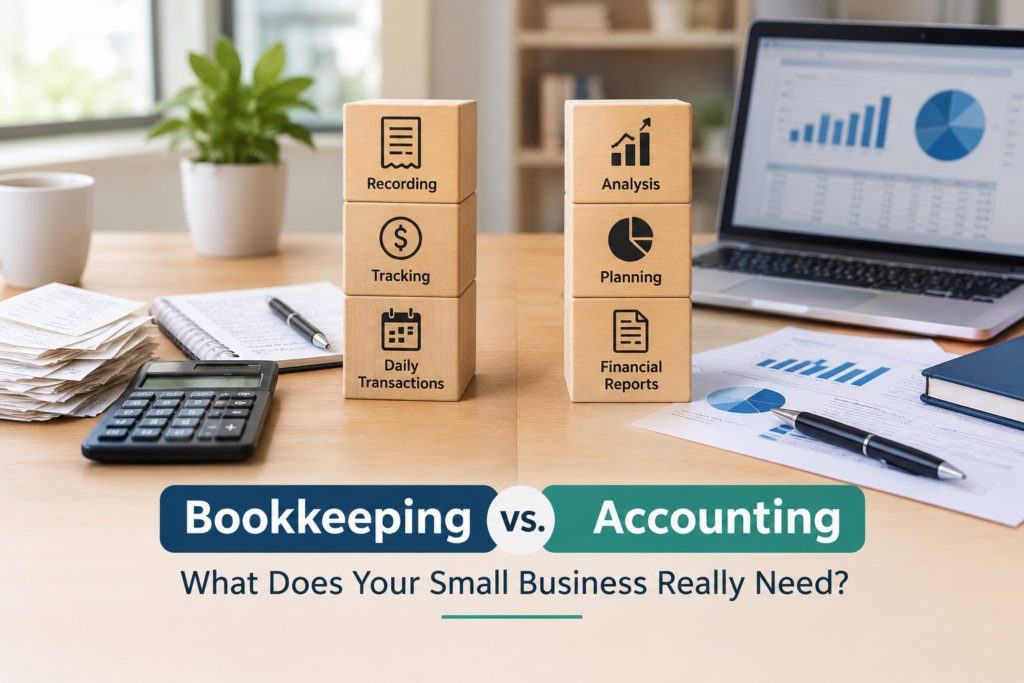
You’ve got a drawer full of receipts, a stack of invoices, bank transactions piling up, and a financial report that doesn’t quite make sense. The question is: who actually handles this, a bookkeeper or an accountant? Understanding bookkeeping vs accounting starts with recognizing that one function focuses on recording financial activity, while the other focuses on interpreting what that activity actually means for your business.
Why Bookkeeping and Accounting Are Different but Connected
Bookkeeping generally centers on maintaining accurate, current financial records, the day-to-day recording of transactions as they happen. Accounting typically involves reviewing, interpreting, and reporting on that financial information once it’s been recorded. Neither function stands alone particularly well. Bookkeeping and accounting work together, one feeds directly into the other, and in many small businesses the line between them blurs depending on who’s doing the work and how the engagement is structured.
What Does a Bookkeeper Usually Do?
A bookkeeper’s responsibilities typically include recording and categorizing transactions, maintaining organized financial records, and reconciling bank and credit-card accounts. This often extends to monitoring customer invoices, recording supplier bills, and reviewing anything that looks uncategorized or duplicated. Keeping supporting documents in order, preparing routine financial reports, and maintaining accounting software also usually fall under this role.
Solid small business bookkeeping gives you a foundation to build everything else on, but the exact scope of bookkeeping services varies depending on the provider and what’s outlined in your service agreement. As transaction volume grows or reconciliation issues start piling up, professional bookkeeping becomes less of a nice-to-have and more of a practical necessity, especially once your own time becomes the limiting factor.
What Does an Accountant Usually Do?
Accounting work tends to involve reviewing bookkeeping records, interpreting financial statements, and evaluating overall financial performance. This can include advising on accounting treatment for specific transactions, preparing adjusting entries, and supporting budgeting or forecasting efforts. Organizing year-end information, addressing more complex reporting questions, and coordinating tax-related information where appropriate round out the picture.
Good small business accounting turns raw numbers into something you can actually use to make decisions. That said, an accountant for small business needs might offer a different mix of these services depending on their qualifications, experience, and what’s specifically agreed upon in the engagement. Not every provider of accounting services performs every function listed here, so it’s worth clarifying upfront what’s actually included.
Bookkeeping vs Accounting: A Practical Comparison
Looking at bookkeeping vs accounting side by side helps clarify where each one fits. Bookkeeping’s primary purpose is accurate, ongoing recordkeeping, usually happening daily or weekly depending on transaction volume. Accounting’s purpose leans toward analysis and reporting, often reviewed monthly, quarterly, or at year end.
Bookkeeping produces the underlying records, reconciled accounts, categorized transactions, and routine reports. Accounting takes those records and places them into broader context, evaluating trends, flagging issues, and supporting bigger decisions. Bookkeeping plays the larger role in daily financial organization, while accounting plays a larger role in planning and interpretation. In practice, the two overlap constantly, and many financial questions require input from both.
Does a Small Business Need Both Services?
Whether you need one or both depends on a handful of factors: your transaction volume, the number of financial accounts you’re managing, and your business structure. Reporting needs, payroll or sales-tax activity, and how quickly you’re growing all factor in too, along with financing requirements, your own experience with financial management, the time you actually have available, and how complex your decisions have become.
A very small operation might get by with regular bookkeeping and only occasional accounting review. A business that’s growing or juggling more complexity often benefits from ongoing support in both areas at once. Strong business financial management really comes down to pairing accurate records with informed interpretation, not necessarily hiring two separate people to do it. Not every small business needs a dedicated professional in each role.
When Should You Consider Professional Support?
A few warning signs tend to show up consistently: accounts that haven’t been reconciled in a while, transactions sitting uncategorized, or personal and business expenses that have gotten tangled together. Reports with balances that don’t add up, customer or supplier records that look off, or bookkeeping that’s fallen several months behind are all signals worth paying attention to.
If you can’t explain why your cash flow shifted last quarter, if the business is expanding faster than your systems can track, or if a lender has asked for financial statements you don’t have ready, it’s probably time to bring in support. The same goes if financial administration is eating into hours you’d rather spend running the business. Looking into bookkeeping help for small business owners can access is often the first practical step. Outsourced accounting services can work well for businesses that need consistent support without building out an internal position, though it’s worth confirming exactly what any given provider covers before assuming it matches your needs.
How to Decide Which Service Your Business Needs
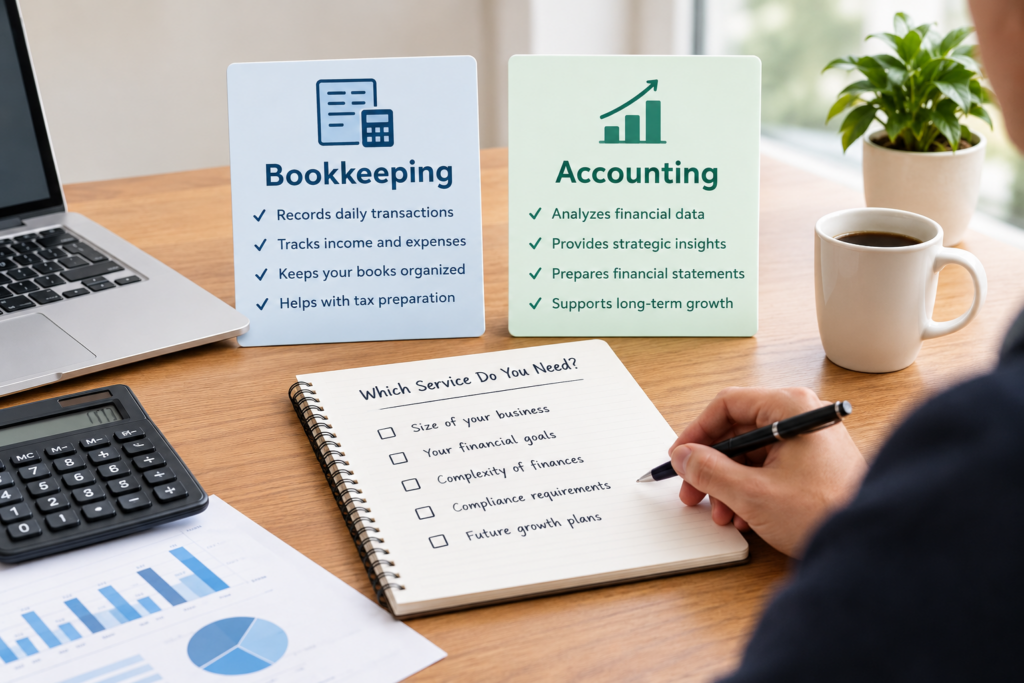
If your main problem is incomplete, inconsistent, or unreconciled records, bookkeeping support is likely the right starting point. If your records are solid but you need help interpreting them, adjusting entries, or building out reports, accounting assistance makes more sense. Some businesses need both working together on an ongoing basis. If your situation touches on tax filing or legal questions outside a provider’s scope, those areas call for a specialist in that field specifically.
Before signing on with any provider, it’s worth asking a few direct questions: Which tasks are actually included? How often will records be updated? Who’s responsible for supplying documents? What reports will you receive, and how are corrections and questions handled? Are year-end or tax-related services part of the package? Which accounting software do they support, and what stays your responsibility as the owner?
How Rakow & Co. Supports Small Businesses
Rakow & Co. provides accounting services built around fixed monthly packages, with bookkeeping as a core part of that offering alongside payroll, business tax, sales tax, and business advice. Clients work with a dedicated accountant using cloud accounting software like QuickBooks, whether based in New Jersey or working remotely elsewhere in the US.
Sorting out bookkeeping vs accounting for your own business really comes down to understanding what you already have in place and where the gaps are. If your records need attention or you’re unsure which type of support fits your situation, booking a discovery call is a low-pressure way to talk it through.
Frequently Asked Questions
What is the difference between bookkeeping and accounting?
Bookkeeping maintains transaction records, while accounting reviews and interprets financial information for reporting and decision-making.
Does a small business need both bookkeeping and accounting?
The need depends on transaction volume, reporting complexity, business growth, owner capacity, and existing professional support already in place.
When should a small business hire an accountant?
Consider hiring one for complex reporting, financial analysis, business growth, financing needs, year-end adjustments, or significant financial decisions.
Can a bookkeeper help with business financial decisions?
Organized records and routine reports provide useful information, though complex decisions may need an appropriately qualified accountant or adviser.
How do I know which service my business needs?
Incomplete daily records suggest bookkeeping support, while analysis, adjustments, complex reporting, or planning usually point toward accounting assistance.