The year is winding down, but the business hasn’t stopped moving. Invoices are still going out, expenses are still coming in, and somewhere in the mix are a few unreconciled accounts, a stack of missing receipts, and maybe an unpaid invoice or two that slipped through the cracks. This is exactly the moment for a year-end bookkeeping checklist, not a last-minute scramble to organize everything the week taxes are due, but a structured review of what’s already in your records.
Why Year-End Bookkeeping Matters
A thorough year-end review does more than tidy up your files. It produces financial statements you can actually rely on, with income and expenses recorded clearly and consistently. It also makes conversations with your accountant or tax preparer far more productive, since they’re working from records instead of guesswork.
Along the way, this kind of review helps surface unpaid invoices and bills that need attention, along with duplicate or uncategorized transactions that have been sitting unnoticed. It gives you a cleaner starting point heading into the next financial period, and it supports more informed planning and budgeting once the numbers are settled. Consistent year end bookkeeping throughout the year makes this process considerably lighter when December arrives. That said, completed bookkeeping is not the same as a professional tax review, the two work together but serve different purposes.
Essential Year-End Bookkeeping Tasks
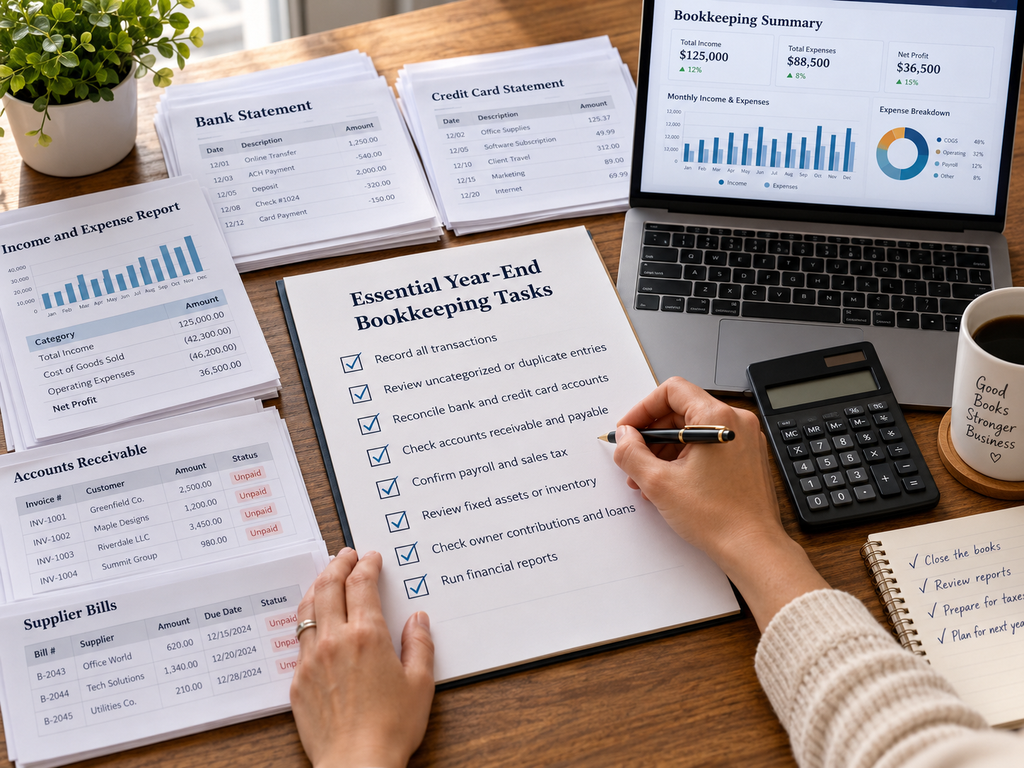
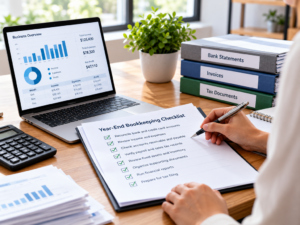
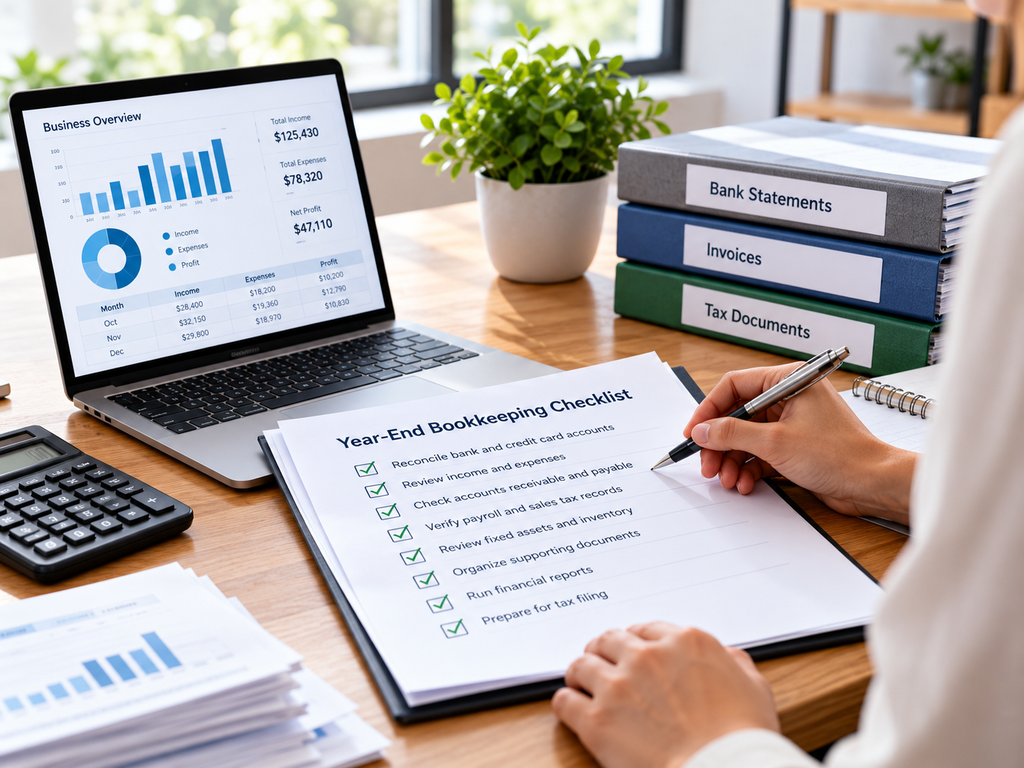
A practical year-end bookkeeping checklist usually starts with confirming that every relevant transaction has actually been recorded, then moves into reviewing anything uncategorized or duplicated. From there, check owner contributions, draws, and distributions, along with any loan balances and related interest.
Where applicable, confirm payroll figures and payroll liabilities, and review sales-tax accounts for accuracy. Look over any fixed-asset purchases or disposals during the year, and check inventory records if your business carries stock. Confirm that supporting documents are retained for everything you’ve recorded, then run preliminary financial reports to see how things look before anything is finalized. Any adjustment you’re unsure about is worth discussing with a qualified professional rather than guessing.
Reconcile Bank and Credit Card Accounts
Reconciliation is simply the process of comparing your bookkeeping records against your actual bank and credit-card statements. This means checking deposits, withdrawals, transfers, fees, and interest, along with identifying outstanding items, duplicate imports, missing transactions, and any differences that don’t have an obvious explanation.
This step should cover every active business bank and credit card account you use, not just the main operating account. It’s worth noting that a matching ending balance doesn’t automatically mean every individual transaction was categorized correctly; reconciliation confirms totals, not classification.
Review Income and Expenses
Take time to review your income sources and expense categories for completeness and consistency. Common issues to watch for include personal transactions that were accidentally recorded as business costs, loan proceeds entered as income, or asset purchases logged as ordinary expenses. Duplicate sales, unprocessed refunds, merchant fees, and uncategorized payments are also worth a closer look.
This step touches on small business year end accounting more broadly, though bookkeeping and accounting aren’t quite the same thing; one handles the recording, the other interprets what those records mean. Anything you’re not confident classifying correctly deserves a second opinion from a qualified professional.
Check Accounts Receivable and Payable
Review your unpaid customer invoices and outstanding supplier bills carefully. Look for invoices that have already been paid but remain marked as open, customer balances that need a follow-up call, or duplicate invoices and bills sitting in the system. Check for supplier costs that were never entered, credits that haven’t been applied, old balances worth investigating, and bills that may have landed in the wrong accounting period. Avoid writing off a receivable or removing a payable without reviewing the full picture first.
Documents to Prepare Before Tax Filing
Depending on your business, your accountant or tax preparer may need bank and credit-card statements, loan statements, payroll reports, and sales-tax reports. Customer and supplier summaries, receipts, invoices, and mileage or travel records often round out the list, along with asset purchase and disposal documents, inventory records, insurance documents, and lease agreements. Prior-year financial statements, relevant tax forms, and your year-end balance sheet and profit-and-loss statement are typically useful too.
Gathering these year end financial records ahead of time, rather than digging for them later, makes a real difference. Every business accounting checklist should be adapted to your specific business structure and activities; not every item on this list applies to every business. Getting an early start on bookkeeping before tax season gives your accountant or tax preparer more time to investigate anything that looks off, instead of rushing against a deadline.
Common Year-End Bookkeeping Mistakes
A few patterns show up often at year-end: waiting until the filing deadline is close, skipping reconciliation on one or more accounts, or mixing personal and business spending throughout the year. Guessing at missing amounts, recording transfers as if they were income or expenses, and ignoring old invoices and bills all create complications down the line.
Duplicating bank-feed transactions, misclassifying loans or fixed assets, and overlooking payroll or sales-tax liabilities are also common. Deleting transactions just to force numbers to match, or making unsupported journal entries, tends to cause more confusion than it resolves. It helps to prepare books for year end gradually rather than closing them out before outstanding questions are answered, and to keep source documents on hand throughout. None of these mistakes automatically leads to penalties, but each one makes your financial picture a little less reliable.
How Professional Bookkeeping Makes Year-End Easier
Certain signs suggest it’s worth bringing in outside support: months of uncategorized transactions, accounts that have never been reconciled, or reports with balances that don’t make sense. Receivable or payable records that look inaccurate, unclear loan or asset balances, and payroll liabilities that don’t match supporting reports are all worth a second look. So it is simply running out of time to keep records current as the business grows.
Rakow & Co. offers bookkeeping services built around fixed monthly packages, along with bookkeeping clean-up support for businesses whose records need attention. Whether you’re catching up on the past year or getting ahead of the next one, working through a year-end bookkeeping checklist with organized records makes the whole process considerably more manageable.
Frequently Asked Questions
What should a small business do for year-end bookkeeping?
Reconcile accounts, review transactions, check receivables and payables, organize supporting documents, and investigate any unclear balances.
How do I prepare my books for tax filing?
Complete reconciliations, correct misclassified entries, organize supporting documents, review reports, and share accurate records with your tax professional.
What financial records should I review at year end?
Review bank statements, credit-card statements, invoices, bills, payroll reports, loans, asset records, financial statements, and relevant tax documents.
Should I reconcile my accounts before year end?
Yes, reconciliation helps locate missing, duplicated, incorrectly dated, or unexplained transactions before your reports are finalized.
When should I start year-end bookkeeping?
Start before your financial year closes, maintaining records consistently throughout the year rather than waiting until the filing deadline.